Choosing the equipment for a comfortable and modern home involves balancing several criteria that carry different weights depending on the room, budget, and actual use. Instead of listing categories of furniture, this article compares the selection parameters that make a difference in daily life: regulatory durability, measurable comfort, and layout consistency.
Durability versus Repairability: What the New Indices Change for Equipment
Since 2025, a durability index applies to televisions and washing machines (decree no. 2024-316 and orders of April 5, 2024, summarized by Household Appliances). This index does not replace the repairability score; it complements it by integrating reliability, wear resistance, and maintenance conditions.
The nuance matters. A well-rated appliance in repairability can frequently break down if its components are fragile. The durability index requires looking beyond the purchase price and aesthetics, which changes the perspective for any household appliance intended to last in a modern home.
To effectively compare the equipment items of a home, it is useful to cross these criteria in a table. Specialized resources allow you to learn more on be-at-home.fr and refine your choices room by room.
| Equipment Item | Priority Criterion | Common Trap | Indicator to Check |
|---|---|---|---|
| Appliances (washing machine, TV) | Overall Durability | Relying solely on repairability | Durability Index 2025 |
| Sofa / Living Room Seating | Foam Density and Suspension | Choosing based on appearance without testing the seating | Foam Density (kg/m³) |
| Lighting Fixtures | Color Temperature Suitable for the Room | Installing the same shade everywhere | Kelvins (warm/neutral/cool) |
| Storage Furniture | Modularity and Actual Dimensions | Underestimating the space taken up with doors open | Overall Dimensions with Opening |
| Thermal Regulation | Zone Programming | Confusing connected and programmable | Compliance with decree no. 2025-1343 |
Thermal Regulation: Programmable or Connected Thermostat, the Real Difference
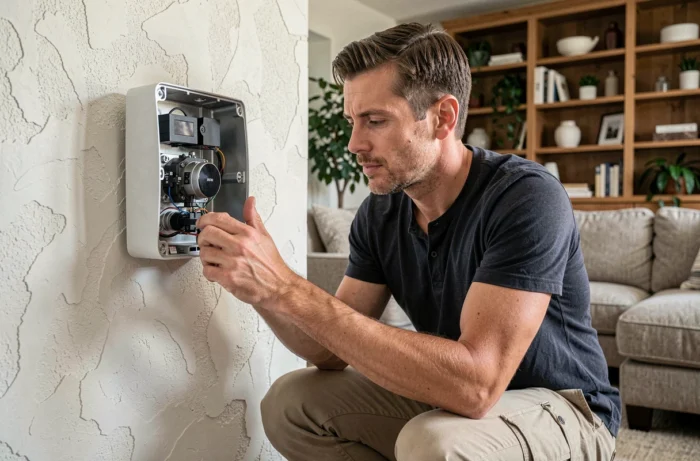
The decree no. 2025-1343 of December 26, 2025 (reported by Choisir.com) mandates automatic and programmable regulation by zone. It does not require a thermostat connected to the Internet or a mobile application. The confusion between the two concepts often leads to unnecessary extra costs.
A classic programmable thermostat, without Wi-Fi, meets the regulations if programming is done by room or zone. The deadline varies by buildings: 2027 deadline for certain new constructions, postponed to 2030 for existing ones. Checking this date before investing avoids paying for a high-end connected device where a programmable model suffices.
The thermal comfort of a modern home relies more on correct zoning than on the sophistication of the interface. A south-facing living room and a north-facing bedroom do not have the same hourly needs. Zone regulation, even simple, corrects this imbalance better than a single thermostat placed in the hallway.
Living Room Comfort: Seating Density and Sofa Choice
The sofa accounts for most of the time spent in the living room. The density of the seat foam determines both immediate comfort and longevity. A density that is too low gives a soft feeling upon purchase, but the seating collapses within a few months.
High-resilience foam retains its shape for several years, while standard foam loses its support quickly. The in-store test remains the most reliable: sit down, stand up, observe if the foam returns to its original shape within a few seconds.
The structure of the sofa is as important as the upholstery. A solid wood frame (beech, dried pine) withstands mechanical stress better than a particle board frame. The fabric or leather does not affect longevity if the base is fragile. Here are the points to check before purchase:
- Seat foam density: prioritize high values for daily use, while lower ranges are suitable for an occasional piece of furniture
- Type of suspension: crossed elastic straps or pocket springs, which provide independent support by seating area
- Frame material: dried solid wood to limit deformation, checking the joints (screws + glue rather than staples alone)
- Overall dimensions with armrests: measure the door passage and circulation space around the furniture once installed
Upholstery and Daily Maintenance
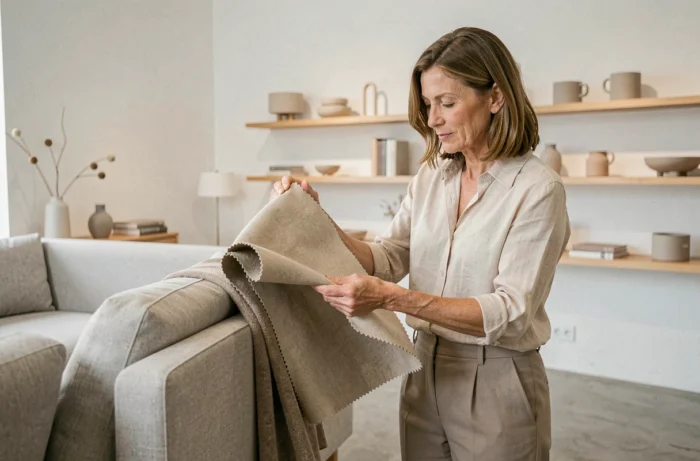
The choice between fabric, leather, and microfiber depends more on lifestyle than style. A household with children or pets benefits more from a removable and washable upholstery than from full-grain leather, which requires regular maintenance.
The color of the upholstery also influences the perception of space in the living room. Light shades visually enlarge the room but show marks more quickly. A subtly patterned fabric hides daily wear better than a light solid color.

Lighting and Interior Layout: Adapting Light to Each Room
Lighting alters the perception of comfort much more than furniture. An unsuitable color temperature strains the eyes or makes a room feel cold. The principle is simple: warm light for relaxation spaces (living room, bedroom), neutral to cool light for work areas (kitchen, office).
Layering three light sources per room produces a more comfortable result than a single ceiling fixture:
- A general lighting (ceiling light or pendant) for ambient brightness
- A functional lighting (desk lamp, under-cabinet lights) for specific tasks
- An accent lighting (table lamp, indirect strip) to create relief and depth in the decor
Layering light sources effectively replaces a powerful central lighting. It also allows for modulating the atmosphere according to the time without touching the furniture.
Choosing long-lasting LED bulbs reduces the frequency of replacement. When combined with a dimmer, they offer flexibility that halogens did not allow, for significantly lower consumption.
Equipping a comfortable and modern home relies more on technical choices than on decorative trends. Foam density, thermal zoning, durability index, and color temperature are the four parameters that separate a pleasant living space from a simply pretty one in a catalog.