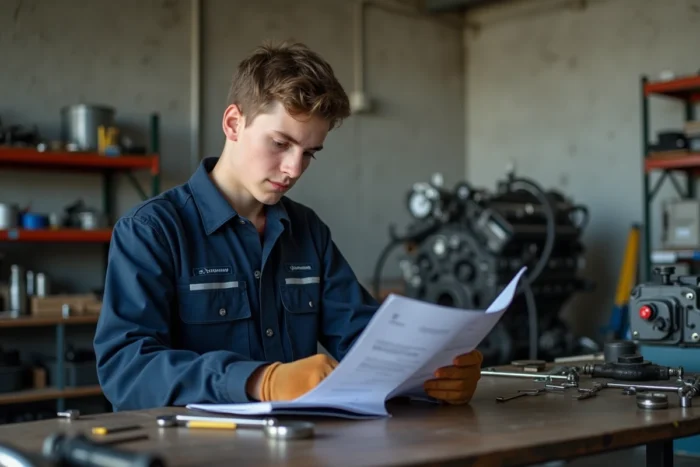
The Labor Code does not contain any provision that explicitly prohibits leaving an apprentice alone in the company’s premises. The absence of a formal prohibition does not mean that the employer has complete freedom. Several legal obligations, related to the apprenticeship contract itself and workplace safety, strictly regulate this situation.
Supervision obligation by the master apprentice: what the Labor Code provides
The apprenticeship contract is a special employment contract. Article L. 6221-1 of the Labor Code requires the employer to provide the apprentice with comprehensive professional training. This training involves the designation of a master apprentice, whose responsibilities are defined in Article L. 6223-8.
The master apprentice guides the apprentice in acquiring skills, competencies, and progressive autonomy related to the profession. Their role is not limited to technical transmission: they organize the assigned tasks, check their proper execution, and adjust the level of difficulty according to the training stage.
An apprentice left without supervision for an extended period is deprived of this guidance. An employer wishing to understand the conditions for an apprentice to work alone must first ensure that the master apprentice remains reachable and able to intervene, even if they are not physically present at all times.
Article L. 6223-8 also specifies that the employer ensures that the master apprentice receives appropriate training. A poorly trained or absent supervisor undermines the overall compliance of the apprenticeship contract.

Risk assessment and isolated apprentice: the employer’s safety obligations
Beyond the training aspect, the employer remains bound by their general safety obligations. The single document for assessing professional risks (DUERP) must include the situation of an apprentice who may work alone, even temporarily.
Working in isolation is not prohibited by the Labor Code, including for a regular employee. Regulations require the employer to assess the level of risk associated with isolation and implement proportionate preventive measures. For an apprentice, this requirement is heightened by their status as a trainee employee, often less experienced in emergency situations.
Criteria that make isolation problematic
- The nature of the tasks assigned: handling dangerous machines, working at heights, or using chemicals without supervision exposes the apprentice to risks that the employer cannot ignore in the DUERP
- The absence of a quick alert system: if the apprentice cannot contact a colleague or supervisor in case of an accident, the employer fails to meet their safety obligation
- The age of the apprentice: a minor apprentice benefits from additional protections, with restrictions on hours, hazardous work, and, in several sectors, the prohibition of being left alone outside the usual premises of the company
The issue does not arise in the same way for a final-year master’s apprentice managing an administrative file and a 16-year-old apprentice on a construction site. The assessment must be individualized.
Branch agreements and sectoral rules on apprentices alone in the company
The general legal framework allows for some discretion, but several professional sectors have tightened the rules in recent years. In construction or maintenance, agreements negotiated since 2023-2024 impose stricter obligations than the Labor Code alone.
What these branch agreements provide
- The mandatory presence of a reachable referent in real-time when the apprentice is working on a client site or construction site
- A traceability of safety instructions provided before each autonomous intervention
- In some cases, the formal prohibition of sending a minor apprentice alone outside the main premises of the company
These sectoral obligations add to the legal foundation. An employer in construction who merely complies with the Labor Code without checking their collective agreement exposes themselves to a breach.
In hairdressing, the situation has also been clarified by unions. The master apprentice must hold a professional certificate or an equivalent diploma to supervise an apprentice in CAP. An employee holding only a CAP does not meet this requirement, making their presence insufficient to cover the absence of the master apprentice.

Termination of the apprenticeship contract for lack of supervision
An apprentice regularly left alone without appropriate supervision has legal recourse. The termination of the apprenticeship contract within the first 45 days can be invoked by the apprentice without any specific reason. Beyond this period, a characterized lack of supervision (dangerous isolation, prolonged absence of the master apprentice) can justify termination for serious breach by the employer.
Recent case law reminds us that the formalities for this termination are strict: written notification, respect for the deadline, proof of the date. An apprentice who leaves the company without complying with these conditions risks losing the benefit of a secure termination, even if the lack of supervision is proven.
The labor inspection can also intervene upon reporting. The DDETS (departmental directorates of employment, labor, and solidarity) are competent to ascertain a breach of supervision obligations and initiate administrative or criminal proceedings.
The legal framework for an apprentice alone in the company is based on a balance between training, safety, and progressive autonomy. An employer who documents their instructions, maintains a reachable referent, and adjusts tasks to the apprentice’s actual level respects the spirit of the system. Those who hand the keys of the premises to a first-year apprentice without any follow-up take a measurable legal risk.