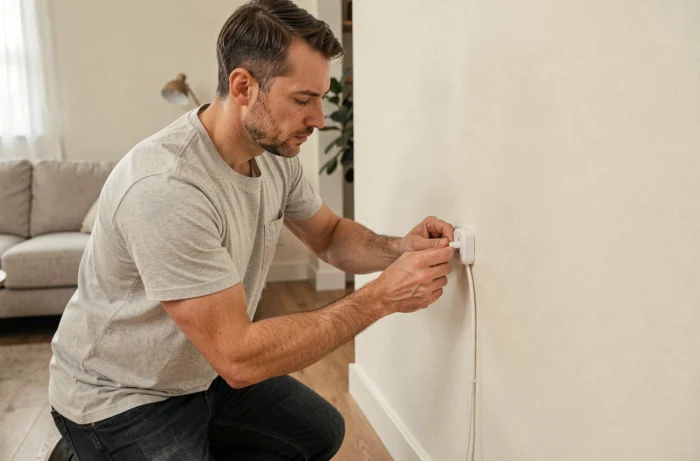
Securing a coaxial cable to a wall without leaving marks means solving a problem rarely addressed by DIY guides: coaxial cable is stiffer and heavier than a USB cable or lamp cord. Its thick sheath resists tight bends, and every poorly negotiated corner puts strain on the fasteners. The right method therefore depends less on decorative preference than on the cable’s physical properties.
Adhesive clips or cable trunking: comparing coaxial cable fasteners
Three types of fasteners cover almost every situation. Their performance varies depending on the cable’s weight, the wall surface and how easily they can be removed.
| Method | Drilling required | Hold on smooth walls | Removal without marks | Suitable for corners |
|---|---|---|---|---|
| Adhesive clip | No | Good (if the surface is clean and dry) | Varies depending on the paint | Fair |
| Nail-in / screw-in clip | Yes | Very good | No (leaves a hole) | Good |
| Decorative cable trunking | Yes (or double-sided adhesive) | Very good | Depends on the model | Good (dedicated corner fittings) |
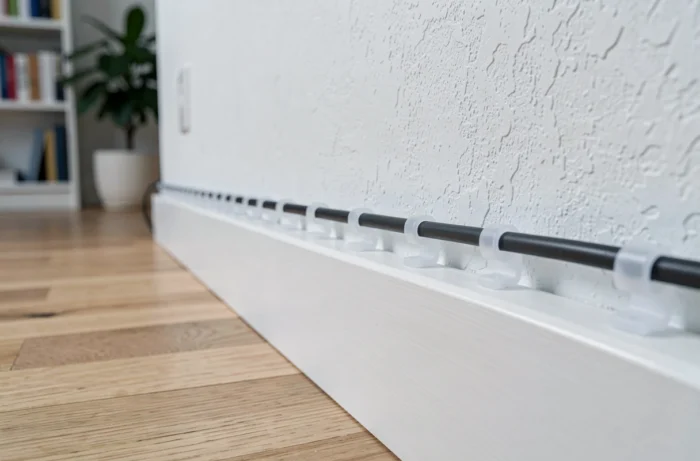
Adhesive clips are appealing for renters, but their reliability depends entirely on the surface. Adhesive works best on a smooth, clean and dry surface; on textured walls or effect paint, uneven contact reduces its holding power. Testing it in an inconspicuous spot behind a piece of furniture before installing the entire run helps avoid disappointment.
Cable trunking is the most polished solution aesthetically: it completely conceals the cable and can be painted to match the wall. The trade-off is that it requires a straight route and often a few fixing screws.
For a detailed look at how to secure a coaxial cable along walls using each of these methods, the final choice comes down to balancing discretion, strength and reversibility.
Adhesive fasteners on painted walls: pitfalls to watch out for
The promise of a “no holes” solution leads many DIYers to self-adhesive clips. With a lightweight cable, the results are often satisfactory. With coaxial cable, there is less room for error.
Removal can sometimes cause more damage than installation
Manufacturers of adhesive fasteners specify that they should be removed by slowly pulling the tab in the intended direction, never by abruptly peeling off the backing. A sudden tug on matte or satin paint can lift the finish. Testing in an inconspicuous spot beforehand is the only reliable safeguard before installing ten clips on a freshly painted wall.
Weight and tension: two different forces
A coaxial cable laid horizontally mainly exerts downward force from its own weight. At changes of direction (wall corners or around a doorway), lateral tension is added, putting different strain on the fastener. Place a clip on either side of a corner rather than just one at the top of the bend to absorb this mechanical stress.
Along a straight run, evenly spacing clips every thirty to forty centimeters is enough to hold the cable without sagging. Shortening the spacing near corners and passageways helps prevent gradual detachment.
Cable trunking and cable-routing baseboards: making coaxial cable disappear
For a durable, invisible finish, wall-mounted cable trunking or a cable-routing baseboard is a modest but effective investment.
- Paintable PVC cable trunking can be attached to the wall with screws or double-sided adhesive, then painted the same color as the wall so it blends into the surface.
- A cable-routing baseboard replaces a standard baseboard and has an internal channel large enough to hold one coaxial cable, and sometimes two.
- Corner fittings (inside, outside and flat) let you follow the perimeter of a room without cutting the cable or forcing it to bend.
The main advantage of cable trunking over adhesive clips is how it distributes the strain. The cable rests in a continuous channel instead of hanging between two fixing points, eliminating the risk of localized detachment.
Coaxial cable in a condominium: check before drilling
In a condominium, running a cable through common areas (hallways, service ducts or the façade) may require prior approval. Drilling into a load-bearing wall or façade affects the building’s common areas. Unauthorized work in a condominium may require the owner responsible to restore the area at their own expense.
For an indoor run within an apartment, this is generally not an issue. But as soon as the cable passes through an exterior wall or runs along a façade, it is best to check the condominium rules or consult the property manager before proceeding.
In a rental property, reversible fasteners (adhesive clips or glued-on cable trunking) avoid the issue of unauthorized drilling. Check the “holes in walls” clause in your lease: some contracts allow small fixing holes, while others do not.
Plan the route before securing the cable: a small step that makes a big difference
Before gluing or screwing anything in place, sketching the cable’s full route in pencil helps you anticipate three common problems.
- A coaxial cable bent at a right angle can lose signal quality. Allowing for a gentle curve (with a bend radius of several centimeters) rather than a sharp kink helps preserve signal transmission.
- Routing part of the cable behind a piece of furniture reduces the number of visible fasteners and therefore its impact on the décor.
- Identifying electrical outlets and heat sources (radiators or heating pipes) helps prevent the coaxial cable from being pressed against an area that could damage its sheath over time.
Planning the route in advance cuts the number of adjustments in half and avoids unnecessary holes. Pencil marks can be erased; screw holes in plaster are much harder to remove.
Because of its stiffness and diameter, coaxial cable is less forgiving of imprecise installation than a flexible wire. Choosing a fastener suited to your wall, testing the adhesive before committing to the full length and planning the route in advance turn a chore into a neat installation without compromising either the signal or the décor.