
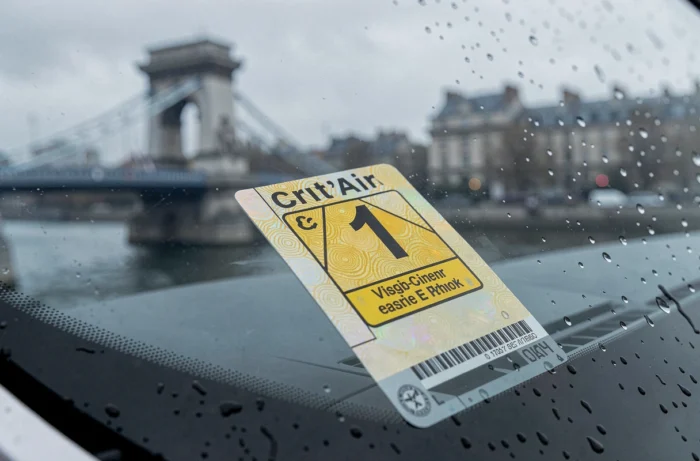
Since January 2017, the Crit’Air sticker has determined which vehicles can access Paris and the municipalities within the A86 motorway. If you’re buying a used car that can be driven in this low-emission zone (LEZ), Crit’Air 1 is the minimum rating for regulatory peace of mind. The choice then comes down to petrol, diesel or hybrid—three powertrains that can all qualify for a sticker, but under very different age and Euro emissions-standard requirements.
Total cost and real-world use: the calculation LEZs won’t do for you
The usual approach is to look for the cheapest Crit’Air 1 vehicle on the used-car market. This overlooks a key factor: how often you actually drive in the Greater Paris LEZ.
A motorist who drives into Paris two or three times a month won’t benefit from a Crit’Air 1 vehicle in the same way as someone who drives there every day. For occasional trips, local exemptions are available in the form of temporary passes, issued by some metropolitan authorities.
These passes allow a vehicle that would normally be excluded to drive in the LEZ for a few days each year. Availability and conditions vary from one local authority to another, and they are no substitute for a compliant vehicle if you drive there regularly.
So before choosing between petrol, diesel or hybrid, consider how many miles you drive each year in restricted areas. A 2011 Crit’Air 1 diesel costs significantly less to buy than a recent hybrid, but its resale value falls faster as restriction schedules tighten.
Conversely, a plug-in hybrid registered after 2006 holds its value better, but its purchase price on the used-car market remains considerably higher. Choosing among used Crit’Air 1 petrol, diesel or hybrid cars therefore depends as much on your overall budget as on how often you need to drive into Paris.

Petrol, diesel, hybrid: registration dates for qualifying for Crit’Air 1
Crit’Air 1 classification works differently depending on the powertrain. Confusing the thresholds could leave you with a non-compliant purchase.
- Petrol and non-plug-in hybrids: vehicles registered from 1 January 2011 that meet the Euro 5 or Euro 6 standard qualify for a Crit’Air 1 sticker. Petrol cars registered between 2006 and the end of 2010 are classified as Crit’Air 2, not Crit’Air 1.
- Plug-in hybrids: they follow the same classification rules as their underlying combustion engine. A petrol plug-in hybrid registered after 1 January 2011 (Euro 5 or 6) is Crit’Air 1. Electric range is not taken into account when determining the sticker.
- Diesel: no diesel vehicle can qualify for a Crit’Air 1 sticker. The newest diesels (registered from January 2011 and meeting Euro 5 or 6) are classified as Crit’Air 2. Many buyers discover this distinction too late.
Even a recent diesel will never be Crit’Air 1. This rules out diesel from the outset for anyone looking for the mauve and purple sticker. Dealerships and sales platforms sometimes describe a Crit’Air 2 diesel as “LEZ-compliant”. That’s currently true in Greater Paris, but offers no guarantees for the medium term.
Crit’Air 1 does not guarantee access everywhere in Paris
Having a Crit’Air 1 sticker allows you to drive in the metropolitan LEZ, which covers the 77 municipalities within the A86. However, LEZs and limited-traffic zones are separate schemes. Within Paris, pedestrianised areas, bus and cycle lanes, and restricted-traffic zones are becoming more common—and these are not determined by a vehicle’s Crit’Air classification.
In practice, a Crit’Air 1 vehicle may still be denied access to certain streets or neighbourhoods for reasons unrelated to its emissions. Municipal orders, restrictions for events or roadworks, and limited-traffic zones being trialled all add to the LEZ regulations.
For a motorist who only visits Paris occasionally, this overlap of rules means Crit’Air 1 is necessary but not sufficient. You still need to check local restrictions in your destination area before each trip.
Regulatory uncertainty: what the National Assembly vote changes (or doesn’t)
In May 2025, the National Assembly adopted an amendment aimed at abolishing LEZs in France. If the bill were passed in its final form and then approved, Crit’Air 3, 4 and 5 vehicles, as well as unclassified vehicles, could once again drive in the LEZs of Paris, Bordeaux and Marseille.
However, the bill has not yet completed its legislative journey. It still needs to be voted on in full by the National Assembly and then reviewed by the Senate. The abolition of LEZs has not been confirmed as of today. The current rules therefore remain in force.
This legislative uncertainty makes the decision harder for used-car buyers. If LEZs are abolished, a recent Crit’Air 2 diesel would regain full freedom of movement, leaving resale value as the only advantage of Crit’Air 1. If LEZs remain in place, restrictions could instead become stricter, making Crit’Air 1 even more valuable.
Which powertrain suits which type of buyer?
Drivers who commute daily in Greater Paris should consider a Euro 5 or 6 petrol car registered after 2011, or a plug-in hybrid from the same period. The hybrid’s higher price is worthwhile if you do a lot of urban driving, thanks to lower fuel consumption in electric mode.
For motorists who rarely drive into Paris, it’s worth looking at the question differently. A Crit’Air 2 diesel, which costs less to buy and is more economical on motorways, may be enough—provided you’re willing to accept the risk of tighter restrictions in future. Temporary exemptions cover the few annual trips into restricted areas, for as long as these schemes remain available.
Buying a used Crit’Air 1 car is not a purely technical decision. It means balancing your upfront budget, running costs, resale value and tolerance for regulatory risk—four factors that the colour of a sticker alone cannot sum up.