In Versailles, when we talk about the right bank and the left bank, no river separates the city. The dividing line dates back to the Ancien Régime: to the northeast of the castle, the Notre-Dame district structures the right bank, while to the south, the Saint-Louis district anchors the left bank. These two poles still dictate the rhythm of life, commuting habits, and the type of housing available.
Understanding their concrete differences allows one to choose a neighborhood suited to their daily life rather than relying on mere reputation.
Impact of the T6 tramway on the accessibility of the left bank of Versailles
Before the extension of the T6 tramway to Versailles-Chantiers at the end of 2023, the southern neighborhoods of the city suffered from a lack of public transport compared to the right bank. Montreuil, Porchefontaine, and Clagny-Glacière remained dependent on cars or buses.
This line changes the game. It directly connects the left bank to the Île-de-France network, without passing through the Rive-Droite station. For a household without a car or working partially from home, the T6 makes the left bank as accessible as Notre-Dame for reaching the south of Paris or the Saclay plateau.
On the right bank, the Versailles-Rive-Droite station remains the fastest entry point to Paris-Saint-Lazare. If you work in western Paris or La Défense, this direct route carries significant weight. Those wishing to live in Versailles with Partimmobilier will find a detailed comparison of the two banks in this service plan.
Atmosphere and quality of life: Notre-Dame vs. Saint-Louis
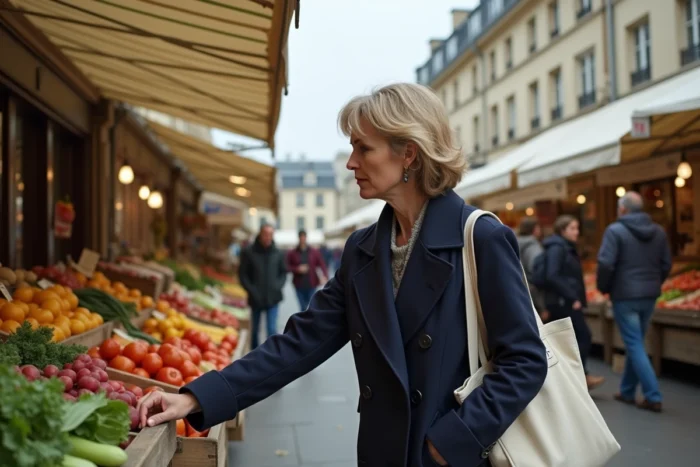
Have you ever noticed that a market can define the identity of a neighborhood? In Versailles, that’s exactly what happens. The Notre-Dame market, open several days a week, enlivens the right bank with its covered halls. It attracts a local clientele and creates a dense commercial hub around the square.
Saint-Louis, on the other hand, is organized around the cathedral and narrower streets. The atmosphere is different: less pedestrian traffic, more independent small shops, a more relaxed pace. Saint-Louis appeals to families seeking residential calm while remaining just a few minutes’ walk from the castle and its gardens.
Tourist pressure and nuisances
The proximity to the castle does not have the same impact depending on the bank. Visitor flows concentrate on the Avenue de Paris and the immediate surroundings of the estate, which affects the right bank more. The management plans for tourist flows, revised since the health crisis, aim to channel these movements, but the Notre-Dame district remains more exposed to buses and summer peak attendance.
The left bank experiences significantly less tourist pressure. In Saint-Louis or Montreuil, the streets remain calm even in high season. For those working from home, this detail is not insignificant.
Versailles right bank or left bank: which profile for which neighborhood
The choice between the two banks depends on three concrete criteria that vary according to your professional and family situation.
- Work location and daily commute: the right bank is better suited if you are aiming for Paris-Saint-Lazare or La Défense (direct line L). The left bank, via Versailles-Chantiers and the T6, is more oriented towards Montparnasse, southern Paris, or the Saclay plateau.
- Type of housing sought: Notre-Dame offers more old apartments in character buildings. Saint-Louis and Montreuil provide more houses with gardens, a format favored by families with children.
- Sensitivity to quiet: projects to reduce car traffic around the Rive-Droite station (30 zones, calm traffic) are gradually narrowing the gap, but the left bank retains a clear advantage in ambient noise.
The case of remote work
Why does this criterion deserve a separate mention? Because it completely redistributes priorities. An employee working remotely three days a week does not need to optimize their daily commute time. Living space and quiet become paramount.
In this configuration, the expanded left bank (Montreuil, Porchefontaine) offers more square meters for a budget equivalent to that of a right bank apartment. The T6 ensures presence days without making a car mandatory.
30 zones and road requalification around Versailles-Rive-Droite
One point that classic neighborhood guides often do not address: the ongoing transformation of the roads around the Rive-Droite station. Since 2022, requalification projects led by the city and Île-de-France Mobilités aim to reduce transit traffic in this area.
In concrete terms, this translates into a gradual decrease in car traffic and the extension of calm traffic zones. For residents of Notre-Dame and the Prés, the sound environment is improving significantly year after year.
This evolution deserves to be monitored. If the trend continues, the comfort gap between the two banks could narrow in the medium term. The right bank would then combine proximity to shops, quick access to Paris, and enhanced quiet, which would justify the price dynamics observed in this sector.
The choice between the right bank and the left bank in Versailles is not just a matter of prestige or price per square meter. It is based on a trade-off between commute time, living space, and noise tolerance. The extension of the T6 and road developments alter this balance each year, making the comparison less fixed than it was five years ago.