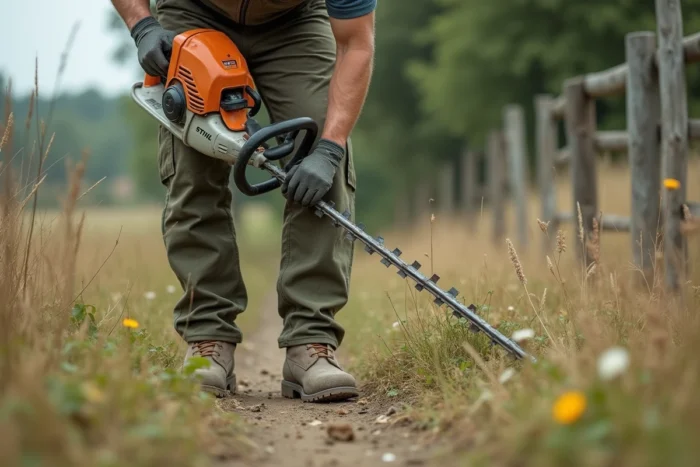
The Stihl FS 261 C-E and the FS 411 C-EM occupy two distinct segments in the range of professional thermal brushcutters from Stihl. One is designed for the regular maintenance of landscaped areas, while the other is for heavy forest clearing. Comparing these two machines is akin to measuring the gap between a versatile medium-power tool and an engine size tailored for dense undergrowth.
Technical Comparison: FS 261 C-E vs FS 411 C-EM
The manufacturer’s data provides the basis for making a choice. The table below gathers the main characteristics from the Stihl Pro catalog.
| Criterion | FS 261 C-E | FS 411 C-EM |
|---|---|---|
| Power | 2 kW | Significantly higher (high range) |
| Max cutting radius (line) | Up to 520 mm | Variable depending on the tool mounted |
| Stihl usage category | Roadside, light undergrowth, meadows | Forest clearing, dense undergrowth |
| Engine management | ErgoStart (C-E) | M-Tronic (C-EM) |
| Heavy blade compatibility | Limited | Yes (heavy mulching blades) |
| Stihl positioning | “Gateway” machine to electric | Pure thermal, intensive use |
A comparison of Stihl FS 261 vs FS 411 on Passion Jardin details the specifics of each model with additional field feedback.
Stihl Usage Category: The Real Selection Criterion
The difference between these two brushcutters is not limited to the raw power of the engine. Stihl classifies the FS 261 C-E in the category of “roadside maintenance, light undergrowth, and meadows.” The FS 411 C-EM, on the other hand, is listed among models approved for forest clearing and the restoration of dense undergrowth.
This distinction has a direct consequence on the cutting tools that can be used. The FS 411 is among the machines compatible with heavy mulching blades, whereas the FS 261 is limited to lighter accessories: line cutting heads, grass blades, or moderate brush knives.
For a grassy area of a few thousand square meters, even with some relief, the FS 261 adequately meets the need. Its cutting radius with line reaches 520 mm, ensuring rapid progress over large surfaces. In contrast, on a fallow land with thick brambles, hazel shoots, or woody vegetation, only the FS 411 accepts the appropriate cutting tools without compromising the mechanics.
Electronic Engine Management: ErgoStart vs M-Tronic
The FS 261 C-E features the ErgoStart system, which reduces the effort required to start. The engine remains with a classic manual adjustment for the air-fuel mixture.
The FS 411 C-EM incorporates M-Tronic technology, an electronic management system that automatically adjusts the fuel based on temperature, altitude, and filter clogging. On paper, M-Tronic simplifies usage and optimizes engine performance.
M-Tronic Reliability in Intensive Use
Feedback from after-sales service compiled by several Stihl dealer networks in France during the 2023-2024 period indicates a point of caution. The frequency of electronic failures on larger displacement models like the FS 411 is higher than on medium-power machines like the FS 261. The main identified cause: overheating of the M-Tronic module due to continuous use in the height of summer.
This observation does not disqualify the FS 411, but it introduces a concrete parameter into the choice. A more sophisticated machine requires more rigorous after-sales service monitoring, and the proximity of a responsive Stihl dealer becomes a factor to consider in the decision.
Weight, Comfort, and Harness: The Impact on Long Sessions
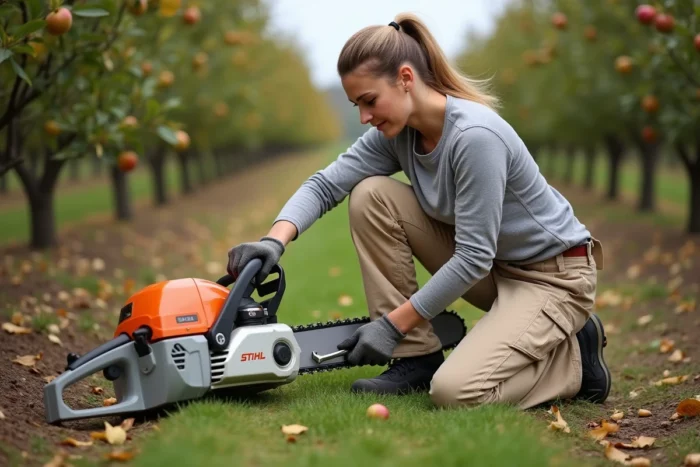
The FS 411 is significantly heavier than the FS 261. Over half an hour of work, the difference is barely noticeable. Over a full day of brushcutting, it changes everything.
The choice of harness then becomes crucial. Both models are worn with a carrying harness, but the higher weight of the FS 411 requires a forestry harness with back support to avoid lower back pain. The FS 261, being lighter, remains comfortable with a standard double-strap harness.
- The FS 261 is suitable for users who spend several hours maintaining varied terrains without excessive fatigue
- The FS 411 requires appropriate carrying equipment and regular breaks to compensate for its weight during prolonged use
- The anti-vibration system exists on both models, but its perceived effectiveness decreases with the power and mass of the machine
Stihl Strategy 2024: The FS 261 as a Transition Machine
Since 2023, Stihl has explicitly positioned the FS 261 C-E as a “gateway” model to electric. The brand targets it at green space managers who do not yet have the infrastructure to switch to fully battery-operated equipment but must already comply with stricter noise and emission standards.
The FS 411, in contrast, remains firmly rooted in pure thermal without any ambiguity. Stihl keeps it in its catalog for forestry professionals whose working conditions (autonomy, power, distance from charging points) make battery use unfeasible in the short term.
This strategic positioning has a practical implication. The FS 261 will likely benefit from more sustainable catalog follow-up and technical developments than the FS 411, whose high-power thermal segment may gradually shrink in the coming years.
The choice between these two Stihl brushcutters hinges on the actual nature of the terrain to be treated. Regular maintenance of meadows, roadsides, or light undergrowth points towards the FS 261 and its 2 kW sufficient for the majority of landscaping tasks. Clearing thick fallow land with woody vegetation requires the FS 411 and its heavy blades, accepting the extra weight and after-sales service constraints of the M-Tronic.