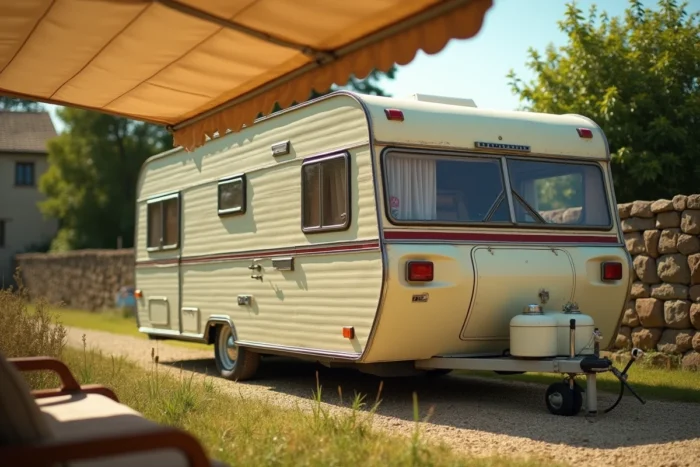
The Rubis caravan is still traveling on French roads, regularly appearing on classified ad sites, yet its origin remains unclear for many potential buyers. Who is behind this name? The answer lies in one word, Trigano, but the reality of this affiliation deserves to be detailed. Because Rubis is not an independent manufacturer: it is a brand integrated into an industrial group, with a specific product positioning and distribution network.
Rubis in the Trigano organizational chart: brand, label, or range?
On the Trigano group’s institutional website, Rubis is listed in the “our activities – caravan” section, alongside other brands in the portfolio. The dedicated page exists in several languages (French, English, German, Italian, Spanish), confirming an industrial integration on a European scale.
The point that escapes most content on the subject: Rubis operates more like a finishing label than as an independent manufacturer. The systematic coupling with the “R Premium” line in commercial communication confirms this. Rubis and R Premium share a common iconography, a unified graphic treatment, and target the same customer segment.
| Criterion | Rubis (Trigano brand) | Classic manufacturer brand |
|---|---|---|
| Legal status | Brand activity integrated into the group | Identified autonomous entity or subsidiary |
| Presence in Trigano brochures | Discreet, not in main catalogs | Own catalog, separate visual identity |
| Distribution network | Exclusive dealerships, limited coverage | National or European multi-brand network |
| Positioning | Upmarket, customization | Variable depending on the brand |
| Complementary line | R Premium (higher finish) | Internal sub-ranges |
This table highlights an atypical operation. Rubis does not have its own public catalog, does not communicate in its name at trade shows, and remains backed by Trigano’s infrastructure for design and production. To learn more about the Rubis caravan, this affiliation with Trigano is the starting point for any serious research.
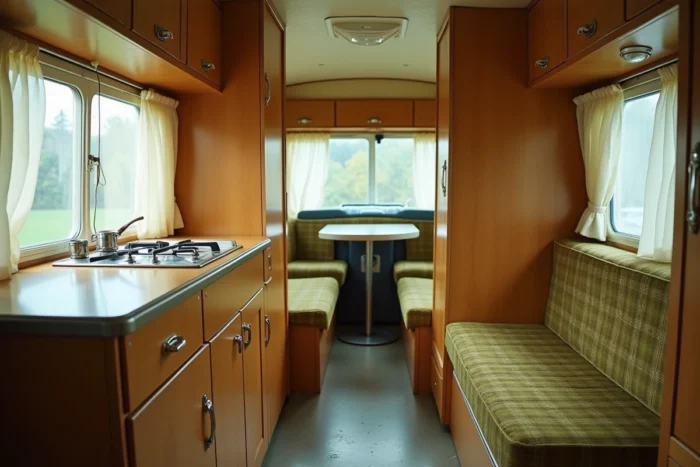
Selective distribution of Rubis caravans: a restricted network by choice
The commercial strategy of Rubis does not rely on mass distribution. The Fabre-Caravanes dealership, based in the Southwest, positions itself as exclusive dealer for several departments (Carcassonne, Toulouse, Tarn, Ariège). This limited territorial network contrasts with the logic of large multi-brand networks that cover the entire territory.
This selective distribution has direct consequences on the second-hand market. Rubis caravans are less widespread than models distributed by major brands, creating a double effect: a certain rarity in the secondary market, but also difficulty in finding a specialist for maintenance or parts outside the areas covered by exclusive dealerships.
What the rarity of the network implies for the buyer
- Access to new models requires visiting a referenced dealership, often far away if one does not reside in the Southwest or in the identified distribution areas.
- Specific Rubis spare parts and accessories pass through the Trigano network, but delays may vary depending on local availability.
- In the second-hand market, the absence of a standardized price reference (no widely circulated valuation) makes evaluating a given model more challenging than for a widely distributed brand.
Rubis range 2026: what the current models reveal
The 2026 collection, as presented by Fabre-Caravanes, includes several references: Rubis 495 M, Rubis 410, Rubis 420, Rubis 395, and even older models still in the catalog (Rubis 450 vintage 2023, Rubis 310 vintage 2022). The Rubis 495 M, presented as a new model, features a fully electric system for heating, water heating, and blinds, while still using gas for certain equipment.
The construction uses full polyester (roof and sides), white aluminum rims, and a slatted bed base. This level of finish, combined with a large shower and studio-type layout, confirms the brand’s high-end positioning.
Rubis compared to the rest of the Trigano range
The Trigano group distributes many caravan brands across Europe. Rubis stands out for its refusal of standardization. While other brands in the group prioritize volume and national coverage, Rubis focuses on customization and support at the dealership. The dealer does not just sell: they advise, allow testing, and adapt the configuration to the customer’s needs.
However, this approach comes at a cost. The lack of strong institutional communication (no visible presence in Trigano’s public brochures) limits Rubis’s visibility among the general public. The brand primarily thrives on word-of-mouth and online communities of enthusiasts.
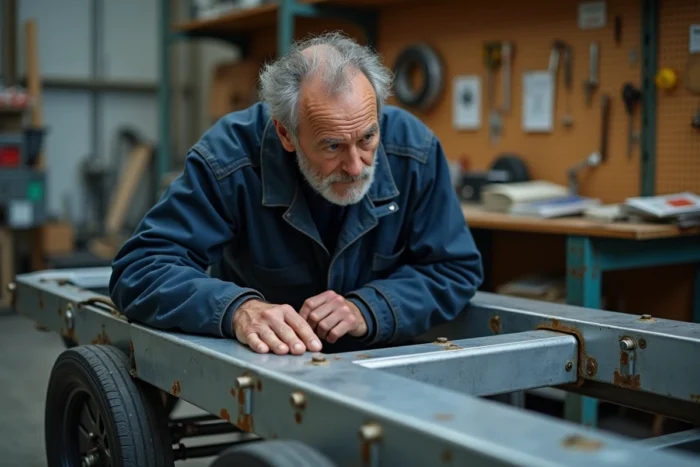
Used Rubis caravan: specific points of vigilance
On Facebook groups dedicated to caravans, a recurring question is: why are there so many Rubis for sale? The answer likely lies in the combination of two factors: an aging installed base (some models are over ten years old) and a range renewal that pushes owners to sell to upgrade.
The absence of a widely circulated official valuation complicates transactions. For a buyer, this means needing to cross-reference several sources (ads, forums, dealerships) before forming a realistic idea of a given model’s price.
- Check the correspondence between the announced vintage and the actual equipment present (finishes vary from year to year).
- Ensure that the polyester structure does not have micro-cracks, especially on models exposed outdoors without an awning.
- Inspect the electrical circuit, especially on recent models with mixed (electric and gas) propulsion.
The Rubis caravan remains a unique case in the French landscape of recreational vehicles. A discreet brand backed by an industrial giant, it cultivates a niche positioning that appeals to connoisseurs but confuses buyers used to traditional channels. Its longevity in the second-hand market attests to real robustness, provided one knows where to look and what to check.