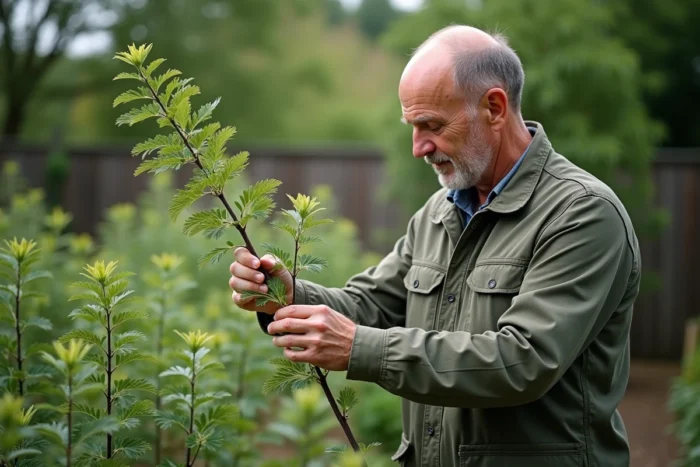
An annual growth rate exceeding 1.5 meters places the rhus viminalis among the spectacularly growing trees, even in poor soils or those subject to water variations. Despite its vigor, nutritional deficiencies can hinder its momentum, especially in the early years.
Propagation by cuttings shows an unusually high success rate, provided that certain temperature and humidity parameters are respected. However, prolonged exposure to shade can permanently compromise growth, revealing the species’ light requirement.
An astonishing lilac tree: origins, characteristics, and growth of melia azedarach
The rhus viminalis, also known as false bamboo, shakes up the benchmarks in gardens around the globe. Native to South Africa, this member of the Anacardiaceae family has carved out a prime spot in Australia, precisely because it fears neither soil poverty nor drought. Its tolerance to negative temperatures, down to -8°C, gives it the appearance of a survivor, appreciated for its robustness and adaptability. Its evergreen foliage, with a vibrant and dense green, resembles bamboo in elegance, without sharing its fragility. The rhus viminalis easily reaches two to five meters in height, making it suitable as a privacy screen, structural hedge, or solitary tree, depending on preference. In spring, it punctuates its branches with small discreet flowers, grouped together, adding a precious touch to the whole. What immediately captivates? The rapid growth of rhus viminalis, a true asset for those who want to quickly structure or energize their space. Its vigor, combined with unwavering hardiness, makes it the solution for impatient gardeners eager to enhance local biodiversity without sacrificing aesthetics. In short, the false bamboo ticks all the boxes: beauty, diversity, and autonomy in the garden, without compromise.
What are the secrets to successful cultivation and easy maintenance?
To give the rhus viminalis every chance, soil choice should be deliberate: prefer well-draining ground, regularly enriched with compost or well-rotted manure. This is not a luxury but the key to allowing roots to breathe and ensuring a solid anchor. For the first two years, watering remains essential; afterward, the plant takes over thanks to its drought resistance. Autumn is ideal for planting, giving the shrub time to spread its roots before the heat sets in. To propagate rhus viminalis, two options stand out, to choose according to your priorities:
- Cuttings appeal for their speed and reliability, especially when maintaining suitable humidity and temperature.
- Seeding favors hardiness and the selection of robust specimens.
Minimal maintenance is sufficient: light pruning at the end of winter stimulates branching and helps maintain a harmonious shape. Regarding adversaries, the rhus viminalis may attract aphids and red spiders, which are fond of young shoots and flowers. Nothing irreversible: the presence of ladybugs often resolves the issue without resorting to chemical products. Installing a rhus viminalis is betting on patience and simplicity. Regular care gradually transforms this tree into a lasting ally, whose rapid growth and elegant silhouette assert themselves discreetly, season after season.

Why choose melia azedarach: benefits for biodiversity and ideas for use in the garden
The rhus viminalis operates in the shadows, but its impact on the garden becomes apparent very quickly. It naturally attracts bees and butterflies, offering nectar and pollen at a time when other species are still awaited. This boost to biodiversity energizes local life and strengthens food chains, supporting a whole segment of small wildlife. As for its uses, the possibilities are numerous and concrete. Here are some ways to integrate rhus viminalis into your space:
- Create a dense hedge to preserve privacy and structure the landscape.
- Install a green screen to temper the wind and promote a mild microclimate.
- Plant it alone to mark a focal point, where its dense foliage draws the eye.
Its roots stabilize the soil, naturally limiting erosion on sloped terrains. The foliage, rich in tannins and polyphenols, nourishes the soil and stimulates the growth of neighboring plants. Some knowledgeable gardeners infuse leaves and branches to perpetuate ancient medicinal practices, used to soothe pain and inflammation.
| Benefit | Direct effect |
|---|---|
| Subtle flowering | Attracts pollinators |
| Dense foliage | Creates shade, protects from wind |
| Bioactive compounds | Improves soil structure |
Installing a rhus viminalis is choosing a vibrant garden, where the silhouette of a sturdy tree shelters the discreet effervescence of the seasons. Nothing ostentatious, but an impact that asserts itself, year after year, over time and through blooms.