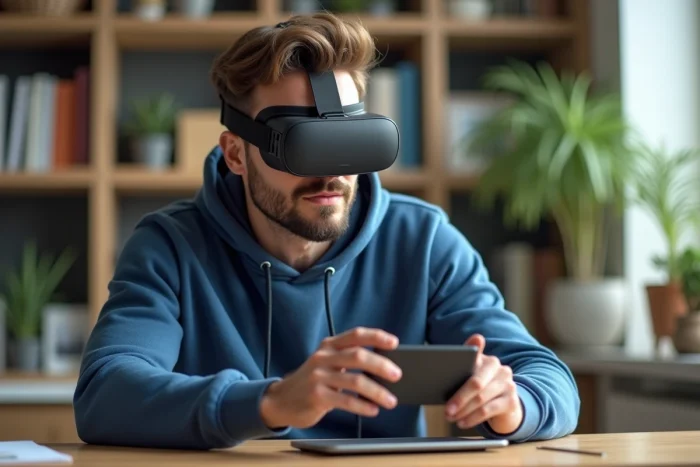
The previous generation of Pico headsets was launched less than a year after the official announcement, a rare pace for the VR industry. On the parent company side, ByteDance, the rule remains the same: keep everything under wraps regarding schedules, sow doubt among competitors, and mislead observers.
Driven by the rise of Meta and the emergence of new rivals, the Pico 5 is set to be the centerpiece of a tight strategy. Leaks suggest an ambitious hardware leap and a completely revamped software, while speculation about the release date of the Pico 5 is multiplying.
Pico 5: A New Step for Virtual and Augmented Reality
You can immediately sense the ambition of ByteDance behind the design of the Pico 5. With this headset, the brand is more than ever showcasing its desire to redefine the virtual reality and augmented reality experience, whether in the family living room or during sharp professional sessions. Behind the scenes, the industrial partner Goertek plays the card of rigor and precision. The result: Pico offers a more accomplished XR generation, inheriting the advancements seen in the Pico 4, Pico 4 Ultra, and Pico 4S.
The year 2026 is shaping up for this launch, with a strong idea: to offer two distinct formats. On one side, an ultra-light version inspired by glasses; on the other, a headset with a more conventional look. This dual choice gives users the freedom: maximum mobility or long-duration immersion sessions, depending on their needs. In terms of pricing, the announced range (from $1500 to $2000) clearly shows that the brand is targeting the high-end market, betting on the quality of the embedded components.
From a technical standpoint, the bar is set high. Future users of the Pico 5 will enjoy micro-OLED 4K screens with a record density: 4000 PPI. Such a level of detail has never been offered on a headset ready to appeal to the general public. A custom chip will lower passthrough latency well below 12 ms, for a seamless mixed reality. Additionally, the GameTop platform, conceived by ByteDance, will enrich the offering of games and immersive experiences right from the start.
Whether viewed from the perspective of an enthusiast of virtual reality headsets or a company seeking new training or collaboration tools, the Pico 5 positions itself at the crossroads of virtual reality and augmented reality. This fusion, made possible by real industrial and technological choices, heralds a paradigm shift in the XR approach.
When Will the Pico 5 Be Available and What Do We Know About Its Launch?
Insider information from production lines tightens the timeline: release expected in 2026. This schedule reflects the strategy of the Pico/ByteDance duo: to launch its new generation of virtual reality headsets right as the market reinvents itself. Official communication remains measured, but initial confirmations suggest a global rollout, with no significant differences from one continent to another.
Two variants clearly mark the roadmap for this model: traditional design on one side, ultra-light version inspired by glasses on the other. This choice aims to cater to both immersive gaming enthusiasts, companies focused on training, and professionals who prioritize lightness in remote collaboration. Prototypes suggest concrete advancements: rethought comfort, increased portability.
In terms of pricing, the range remains set between $1500 and $2000. This policy is explained by the integration of high-end components and the standard arrival of the GameTop platform, a product of ByteDance innovation. When pre-orders open, visibility promises to be maximal: public demonstrations, dedicated events, and targeted campaigns to attract attention. The augmented reality and mixed reality sectors are simply poised to change scale.
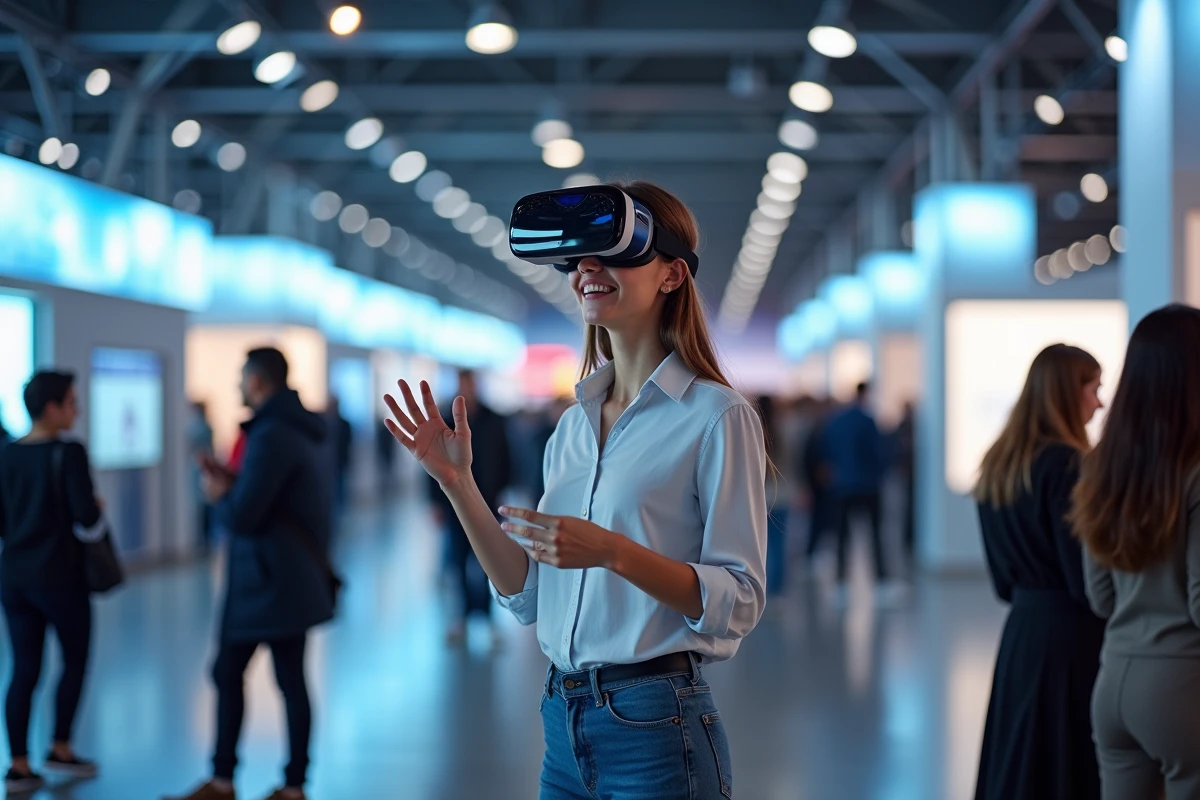
Games, Experiences, and Innovations: What the Pico 5 Promises to VR/XR Enthusiasts
With this new generation, virtual and mixed reality headsets are taking a real step forward. The Pico 5 relies on new micro-OLED 4K screens offering unprecedented sharpness: 4000 PPI on the counter. The result: precise images, finely crafted graphics, and an enhanced sense of immersion in both games and sophisticated professional applications.
For users attracted to mixed reality, the technology goes further: a specific chip manages passthrough, keeping latency below 12 ms. This allows for the seamless overlay of reality and the virtual world, enabling a wide range of uses: technical training, creative brainstorming, interactive works… The scenarios are multiplying.
The GameTop platform will be integrated from the start. To quickly grasp the extent of the promises of this model, here are the main expected features:
- Access to a vast library of PC VR games and immersive experiences designed to leverage the hardware.
- An expanded field of view and fast touch interfaces to enhance daily comfort of use.
- Increased lightness, ensuring a pleasant wear even during long sessions.
Here, performance serves a renewed experience: virtual reality and augmented reality gain in naturalness, comfort, and possibilities. Behind these figures and announcements, a whole new relationship to immersion is emerging, ready to disrupt the habits of both enthusiasts and newcomers. The curtain has not yet been lifted, but already, the XR stage is holding its breath in anticipation of the Pico 5’s debut.