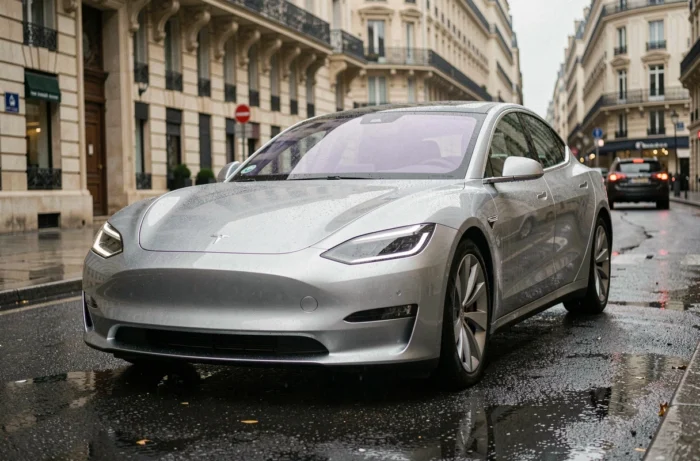
In a dealership parking lot, the change is quickly noticeable: the labels display hybrid engines where diesel dominated just three years ago. In 2024, the French automotive market continued its transformation, but not in the direction many expected.
Sales of new electric and plug-in hybrid vehicles accounted for 25.7% of the market, down from 26.2% in 2023 according to the Data and Statistical Studies Service. The circulation of gasoline, gas, and electric vehicles increased by 7.6% while diesel cars decreased by 4.7%.
Euro 7: What Changes Beyond Exhaust Emissions
When talking about anti-pollution standards, one naturally thinks of exhaust gases. The Euro 7 regulation, adopted in 2024, broadens the scope. Brake and tire abrasion is now included in the regulatory framework, which also affects electric vehicles, often heavier than their thermal counterparts.
This regulation will apply to new types of cars and light commercial vehicles starting at the end of 2026, and then to all new vehicles concerned one year later. For manufacturers, this means rethinking the materials for brake pads and tire composition from the design phase.
The details of these regulatory changes and their practical consequences can regularly be found in auto articles on Actu Auto Buzz, which follow these topics over time.
Durability of Electric Batteries: A Regulatory Threshold for Buyers
Buying a used electric vehicle without knowing the condition of the battery is a risk that deters many buyers. Euro 7 provides a concrete response by setting minimum energy capacity thresholds for model approval.

The figures are precise: 80% capacity preserved up to five years or 100,000 km, then 72% up to eight years or 160,000 km, depending on which limit is reached first. These thresholds concern vehicle approval, not directly the commercial warranty offered by each manufacturer. Feedback varies on this point, as some brands already offer battery warranties that are more generous than this regulatory floor.
For the used market, this standard creates a foundation of trust. A vehicle approved under Euro 7 must have been designed to meet these thresholds, providing an objective benchmark at resale.
Battery Passport and Traceability: What the European Battery Regulation Prepares
The European battery regulation, applicable since February 2024, gradually introduces a traceability requirement that will transform the industry. The idea is simple on paper: each electric vehicle battery will have a digital passport containing its history, chemical composition, and performance.
In practice, manufacturers must adapt their supply chains to document the origin of raw materials. This includes cobalt, lithium, nickel, and manganese. The battery passport will become mandatory starting in 2027, with full deployment expected between 2027 and 2036.
What This Changes for Vehicle Purchase
For a buyer, this digital passport will allow them to verify the health status of a battery before purchase, somewhat like a maintenance log, but standardized across Europe. Used vehicle professionals see it as a lever to reassure customers and structure resale prices for electric vehicles.
- Access to the charging and degradation history of the battery, documented since leaving the factory
- Traceability of the raw materials used, addressing growing demands for responsible sourcing
- Standardization of data between manufacturers, facilitating comparisons between used models
Plug-in Hybrids: A Gap Between Theoretical Consumption and Real Use
Plug-in hybrids are increasingly occupying a place in manufacturers’ ranges, driven by their tax advantages and low consumption on paper. In practice, the reality is more mixed. In real conditions, these vehicles can consume several times more than their technical specifications, especially when the battery is empty and the thermal engine takes over alone.

This discrepancy is explained by the usage profile. A plug-in hybrid charged every night at a home outlet and used for short trips lives up to its promises. The same vehicle used on the highway without intermediate charging behaves like a thermal vehicle weighed down by the battery’s weight.
Choosing Based on Daily Use
Before signing, it’s wise to ask a simple question: does the home-to-work commute fit within the electric range of the targeted model? If the answer is yes and there is a charging point available, the plug-in hybrid remains relevant. If long trips dominate, a conventional hybrid or a recent thermal vehicle may prove more economical on a daily basis.
- Check the real electric range (not the WLTP value, which is often optimistic) by consulting user feedback
- Estimate the frequency of possible charging: home, work, public charging stations nearby
- Compare the additional cost at purchase against a non-plug-in hybrid over the expected ownership duration
Automotive Market 2024: A Reshaped Landscape
The coexistence of thermal, hybrid, and electric vehicles is reshaping manufacturers’ priorities. Renault, Citroën, and other French groups are adjusting their ranges model by model, based on regulatory constraints and buyer expectations. The 2024 Paris Motor Show confirmed this trend: the new models presented mixed electric SUVs, hybrid city cars, and concepts that straddle the two.
The real change in 2024 is not only reflected in sales figures. It is happening in regulation, with Euro 7 and the battery passport, which lay sustainable foundations. Models approved in the coming years will need to meet sustainability criteria that did not exist five years ago.
For the buyer, this means better-documented vehicles, more reliable batteries in the long term, and a used electric vehicle market that is gradually becoming clearer.